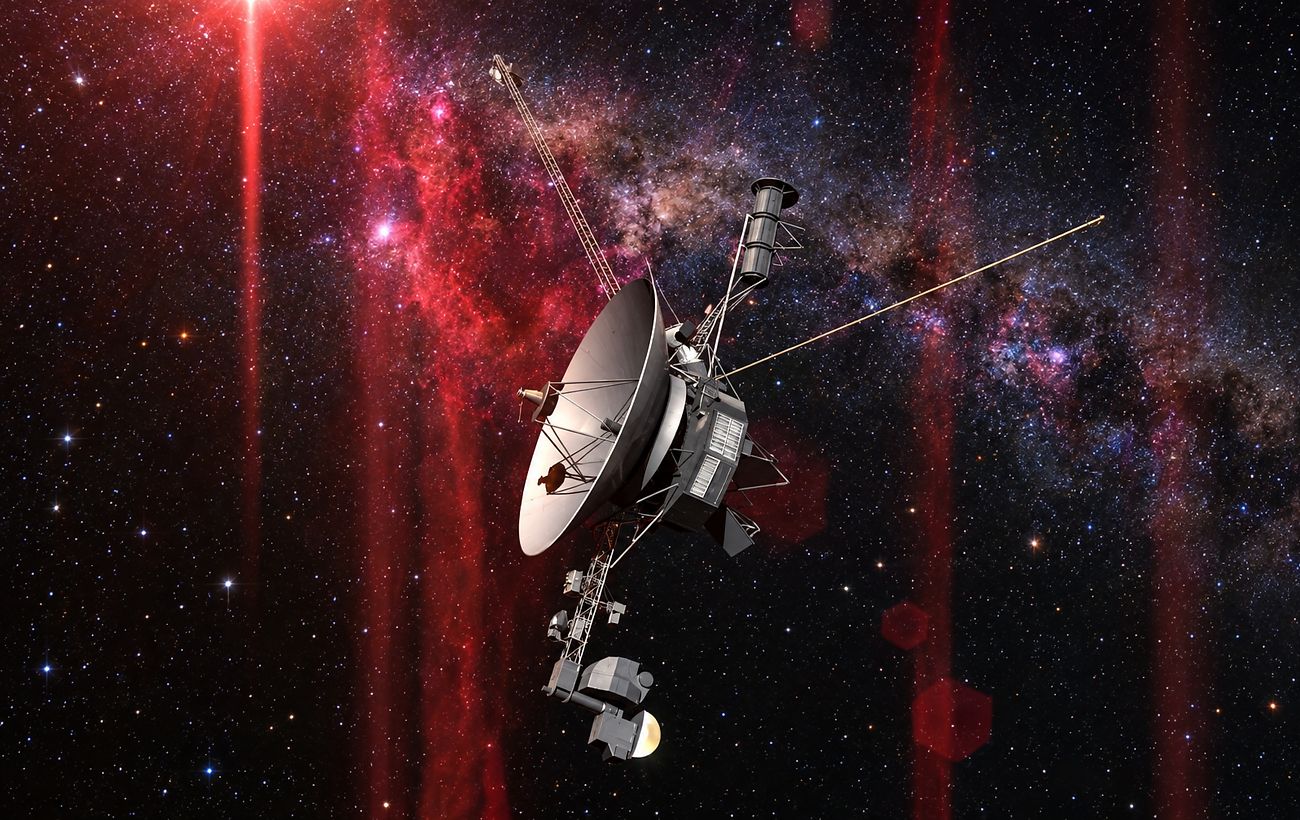
Legendary NASA probe Voyager 1 reaches one light-day distance from Earth
Spacecraft Voyager 1 has set a historic milestone by moving one light-day away from Earth, exceeding 25 billion kilometers.
 💡Tech
Photo: RBC-Ukraine
Key points
- Voyager 1 is now one light-day away from Earth
- The distance covered exceeds 25 billion kilometers
- Both probes launched in 1977 and have entered interstellar space
- NASA engineers are optimizing power to extend mission life into the 2030s
Spacecraft Voyager 1 has crossed another remarkable boundary in its decades-long journey through deep space. As of November 18, 2026, the probe has traveled far enough from Earth that a radio signal now takes a full 24 hours to reach it, covering a distance of over 25 billion kilometers. NASA plans to celebrate this historic milestone by inviting space enthusiasts to beam Morse code signals into the sky.
Why Voyager 1 outpaced its twin
Both probes were launched in 1977 just two weeks apart, with Voyager 2 embarking on its journey first. However, Voyager 1 eventually overtook its counterpart due to a different trajectory selected by NASA scientists to meet specific research objectives. By utilizing gravitational assists near Jupiter and Saturn, the probe gained significant acceleration and headed outward from the solar system.
Meanwhile, Voyager 2 was assigned a more complex route involving flybys of Uranus and Neptune. During its encounter with Neptune to study its moon Triton, the spacecraft altered its trajectory and lost some speed. As a result, it travels slower than its twin and will reach the one light-day mark nearly a decade later.
A remarkably long-lived interstellar mission
Despite their advanced age, both spacecraft have successfully entered interstellar space, with Voyager 1 crossing the threshold in 2012 and Voyager 2 following in 2018. NASA's Jet Propulsion Laboratory continues to maintain operations with the probes despite the gradual depletion of their nuclear power sources. Through careful energy management and shutting down non-essential scientific instruments, engineers hope to keep both historic explorers functioning well into the 2030s.
Source RBC-Ukraine — rbc.ua/ukr/news/voyager-1-vidletiv-svitloviy-den-vid-zemli-17950032… ↗
Read next
 🩺Health
Benefits of Sauerkraut for Older Adults: Dietitian Outlines Optimal Daily Intake
Eating 150 grams of sauerkraut daily helps seniors support their immune system and improve digestive health. Experts emphasize the value of lactic acid bacteria for stren…
How to Choose Underwear for Intimate Health: Expert Advice
Medical professionals advise paying close attention to underwear selection, materials, and washing agents to prevent irritation and discomfort.
 🎓Education
The Global Trend of 'Fake Weddings': A New Way to Celebrate
A growing trend of 'fake weddings' is gaining traction worldwide, offering couples the opportunity to experience a full-scale celebration without the legal requirements o…
 👥Society
Melamine Sponge Cleaning: Safe Usage Rules and Potential Risks
A popular chemical-free cleaning tool requires careful handling as it can damage delicate surfaces.
 👥Society
Chernivtsi native Maryiana Reva appointed Deputy Secretary of the NSDC
The President of Ukraine has signed a decree appointing Chernivtsi native Maryiana Reva as the new Deputy Secretary of the National Security and Defense Council.
 👥Society
How to affectionately address a son in Ukrainian: traditional and tender options
Language experts highlight the variety of warm and affectionate forms to address sons in Ukrainian on the occasion of International Son's Day.